

Types of Cranes: Mobile vs. Static Guide for Industry
The wrong crane choice can create schedule delays, change orders, damaged assets and serious safety risks. Engineers, site supervisors, maintenance teams and safety personnel who lift heavy loads must choose the correct types of cranes to work in tighter spaces and protect people, equipment and budgets. In busy industrial sites throughout Pennsylvania, New Jersey, Delaware and Maryland, it is imperative to understand and choose the correct type of crane, whether it’s a mobile unit, such as a truck crane or crawler crane, or a static crane, such as an overhead crane or gantry crane.
Equip Trucking & Warehousing, LLC supports decisions with heavy hauling, machinery moving, crane hauling and transportation services, bringing crane transport, rigging and warehousing under one experienced family-owned provider.
Why Crane Selection Matters for Safety and Budget
Choosing the appropriate crane type is the most crucial consideration for project safety, as you can easily overload an undersized or mismatched crane. You can also force it into an unstable configuration. For example, using a mobile crane where you need a static crane, or vice versa, could increase the risk of tip-overs, structural failures or uncontrolled load movement, which puts crews and nearby infrastructure in danger.
Financially, over-specifying a crane inflates mobilization, rental and standby costs, while underspecifying it leads to rework, charge orders and time lost while waiting on additional equipment.
Cranes fall into two families: Mobile cranes and static cranes. Each crane type offers different reach, capacity, mobility and setup demands. Thus, selection directly influences project timelines, access planning and the number of lifts that you can safely complete during a shift.
Mobile cranes include:
- Truck cranes
- Truck-mounted cranes
- Rough-terrain cranes
- All-terrain cranes
- Crawler cranes
- Telescopic cranes
- Carry deck cranes
- Floating cranes
- Railroad cranes
Static cranes include:
- Tower cranes
- Hammerhead cranes
- Bridge cranes
- Overhead cranes
- Gantry cranes
- Workstation cranes
- Jib cranes
- Construction cranes
- Other fixed cranes
Partnering with an experienced rigging and hauling firm such as Equip Trucking & Warehousing ensures balancing safety, capacity charts, site constraints and budget when choosing different types of cranes.
Mobile Cranes: Versatility Across Dynamic Job Sites
A mobile crane moves between job sites, which makes them the perfect solution for short-term work, shutdown projects and changing laydown areas. Some types of mobile cranes, such as railroad cranes and carry deck cranes, serve specialized sectors.
Project managers generally choose a mobile crane when they need flexible positioning, fast setup and the ability to support multiple picks across a facility, road corridor or civil infrastructure site.
The crawler crane uses tracks instead of wheels, which distributes weight over a wide area so it can work on soft soil, mud or uneven ground while still handling high capacities and long booms. They are valuable in early-stage construction, wind projects, bridge work and at heavy industrial sites where you don’t have permanent access to fully developed roads.
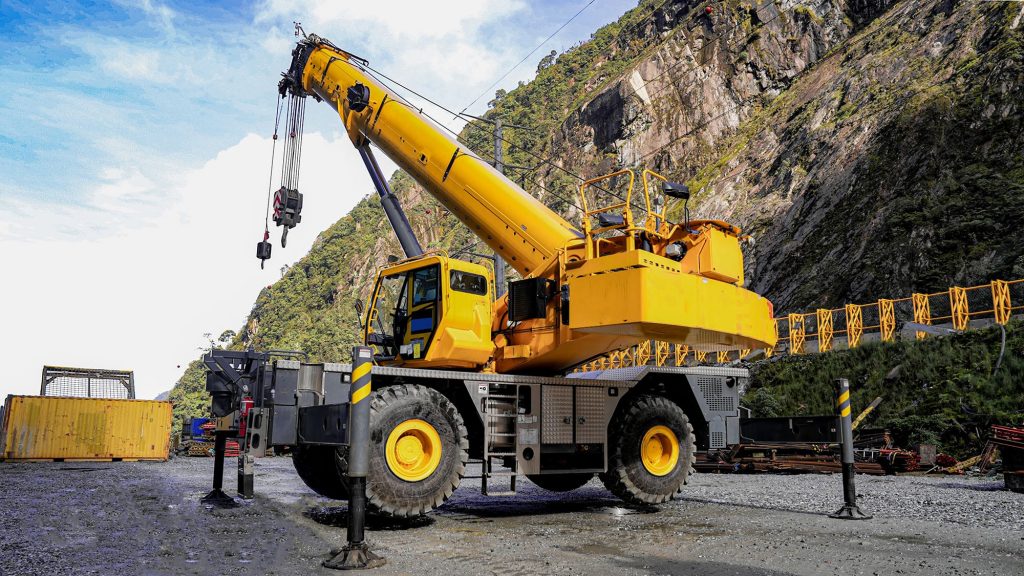
Large tires, high ground clearance and excellent maneuverability make rough terrain cranes perfect for off-road conditions. All-terrain cranes combine highway travel speeds with strong lifting performance on paved and unpaved surfaces, which makes them a strong fit for sites across Pennsylvania and New Jersey.
Truck-mounted cranes and hydraulic truck cranes are excellent for shorter jobs, as they can travel on public roads, arrive quickly and set up with minimal support equipment. They keep mobilization and teardown times low.
A carry deck crane is a compact, highly maneuverable mobile crane that is good for indoor work, congested plants and industrial machinery moves, including equipment transfers to and from warehousing. For niche applications, floating cranes support marine and bridge projects from barges, while railroad cranes work from tracks to maintain and build rail infrastructure.
Static Cranes: Heavy Lifting at Fixed Sites
Static cranes, sometimes called fixed cranes, have anchored foundations. They provide long-term lifting at a specific location or along a defined path. The tower crane is the most recognizable static crane on urban skylines. They provide the height and radius needed to construct tall buildings and major commercial projects. The hammerhead crane is a common form where the jib rotates around the tower.
The setup for tower cranes involves assembling prefabricated sections. Their delivery and disassembly require specialized heavy hauling, rigging and crane relocation planning, areas where Equip Trucking & Warehousing supports contractors with route surveys and transport.
Static cranes, such as overhead crane systems, bridge cranes and gantry cranes, handle repetitive high-capacity lifting along bays and production lines in manufacturing plants, steel mills and warehouses. A workstation crane or smaller jib crane often supports localized repetitive tasks at loading docks or workstations. They improve ergonomics by reducing manual handling and allowing precise placement of heavy components.
These static cranes integrate into the facility layout and may operate daily for years, so their installation, modification and removal require careful rigging, heavy equipment hauling and, in some cases, long-distance relocation, all factors Equip Trucking & Warehousing, LLC can handle for you.
Projects that require static cranes tend to be long-duration operations, where efficiency and reliability over time offset the higher upfront investment. Tower cranes serve multi-year construction projects, while overhead and gantry crane systems support continuous industrial production.
Choosing Between Mobile and Static Cranes
Deciding between a mobile crane and a static crane starts with knowing your project duration and cost. For short-term work (for example, setting equipment, installing rooftop units, bridge picks or shutdown tasks), mobile cranes (such as truck cranes, rough terrain cranes, telescopic crane units, crawler cranes, or carry deck cranes) are generally the more cost-effective choice.
When you have repetitive lifts in the same area over months or years, static cranes, such as tower cranes, overhead cranes, gantry cranes, bridge cranes or workstation crane systems have a lower cost per lift and higher productivity once installed.
Site access and the surrounding environment are also important considerations. In tight urban areas, as you find in parts of Philadelphia’s metro area, space is a premium. Tower cranes, hammerhead cranes and other static cranes that have a small footprint and a broader reach are better.
If your industrial site, utility corridor or mining area has wide-open areas, mobile options, including crawler cranes, rough-terrain cranes, truck-mounted cranes and all-terrain cranes, may work better, as they can reposition around the site as work fronts change. Floating cranes and railroad cranes may be the only realistic solution in sites with limited road access.
The final deciding factors are load weight, radius and the rigging plan. A crane must have sufficient capacity, meet ground bearing requirements, boom configuration limits and stability criteria at the required radius and height.
Equip Trucking & Warehousing, LLC works with clients to review lift requirements, site conditions and crane charts to choose the correct crane type, whether mobile or fixed, and ensure that it fits within the engineered safety margins and regulatory standards. We also help operations managers and safety inspectors avoid last-minute changes that can compromise budgets and/or timelines.
Beyond the Crane: Logistics, Permitting and Transport
Even the best crane choice needs a solid logistics and permitting plan. Large components, counterweights, boom sections and heavy machinery need a safe way to move to and from sites using the appropriate trailers, routing and escorts, especially for oversized or overweight loads. Our Crane Hauling and Transportation Services provide specialized hauling for cranes and related equipment across Pennsylvania, New Jersey, Maryland and Delaware using multi-axle trailers, experienced drivers and detailed route planning.
Regional knowledge matters since each state has its own rules for oversized load permits, allowable travel times, escort requirements and bridge restrictions. Our team manages permitting and compliance for moves in PA, NJ, DE and MD. We work with DOT agencies to secure approvals, schedule transport windows, and minimize disruptions to clients and the public.
During longer projects or multi-phase installs, our warehousing facilities can store crane parts, machinery and process equipment between moves. This gives project teams a reliable staging area and reduces on-site congestion.
By coordinating heavy equipment hauling, storage and crane relocation, Equip Trucking & Warehousing, LLC ensures that cranes and critical machinery arrive when needed, in the correct sequence and ready for assembly. Our integrated approach simplifies logistics coordination for construction managers and procurement officers, while helping safety inspectors and site supervisors maintain control over traffic, lifting zones and laydown areas.
Why Trust Equip Trucking & Warehousing, LLC for Your Heavy Lifting Needs
Equip Trucking & Warehousing, LLC is a family-owned company with over 60 years of experience in machinery moving, rigging, heavy hauling and crane support services in the Mid-Atlantic region. Our team has seen most field scenarios, from tight interior machinery swaps under overhead cranes to complex tower crane mobilizations. We understand how to plan safely around real-world constraints.
Our comprehensive service model sets us apart from others. Our clients can turn to a single partner for crane hauling and transportation services, machinery moving, plant floor rigging, warehousing and coordinated crane location between facilities or job sites. Contact Equip Trucking & Warehousing, LLC for crane hauling and transportation services if you are planning a major crane move or replacement.